Java, Programming
Advanced Java Data Management Techniques
· Eric B.
Efficient data management separates a Java application that scales from one that collapses under load. This guide covers the techniques that actually move the needle: picking the right data structure, controlling memory pressure, handling concurrent access without race conditions, and applying serialization and compression where they count. If you are stuck on a Java assignment that involves any of these areas, Java Assignment Help connects you with developers who specialize in this.
Choosing the Right Data Structure
The first sentence under each Java performance problem is almost always the same: the wrong data structure was chosen.
Java ships with arrays, ArrayList, LinkedList, HashMap, TreeMap, HashSet, and TreeSet, each with a distinct performance profile. Arrays give O(1) random access and the smallest memory footprint. ArrayList adds dynamic resizing with the same O(1) access cost. LinkedList trades random access for O(1) insertion and deletion at any position.
For key-value storage, HashMap delivers O(1) average-case lookup, insertion, and deletion. When you need keys in sorted order, TreeMap provides O(log n) operations backed by a red-black tree. The tradeoff is real: sorted traversal costs roughly 3 to 5 times more per operation than a hash lookup under typical loads.
Graph problems demand a different set of tools. Breadth-first search and depth-first search are the two workhorses for exploring relationships in social networks, dependency graphs, and routing tables. Neither fits neatly into the standard collection hierarchy, so most production code reaches for adjacency lists (Map<Integer, List<Integer>>) to represent edges.
When standard collections fall short, libraries fill the gap. Trove and Fastutil both offer specialized collection implementations that work directly with Java primitives instead of boxed wrapper objects, which cuts memory allocation by 40 to 60 percent on large numeric datasets.
Memory Management in Java
Java’s automatic garbage collector removes most manual memory work, but it does not remove the need to think about object lifetime.
Object pooling is the most direct lever. Instead of allocating and discarding short-lived objects in a tight loop, you allocate a fixed pool at startup and recycle instances. This is standard practice in game engines, network servers, and any path that fires thousands of times per second.
Garbage collection algorithm choice matters at scale. The default G1 collector balances throughput and pause time across most workloads. For latency-critical applications, ZGC and Shenandoah both target sub-millisecond pause times at the cost of higher CPU overhead. You tune the collector by adjusting heap size (-Xmx, -Xms) and GC frequency parameters rather than by rewriting application logic.
Two patterns cause the most preventable memory leaks in Java applications:
- Unreleased resources: database connections, file handles, and streams that are opened but never closed. The
try-with-resourcesblock fixes this mechanically. - Long-lived collections accumulating stale references: a static
MaporListthat keeps references to objects that should have been discarded.WeakReferencebreaks the reference chain without forcing a null check on every access.
Using primitive types (int, long, double) instead of their boxed counterparts (Integer, Long, Double) wherever possible reduces heap allocation. One million int values in an array use about 4 MB. One million Integer objects in an ArrayList use roughly 20 MB plus GC overhead.
Concurrent Data Access
Race conditions in Java come from two sources: shared mutable state accessed by multiple threads, and incorrect assumptions about visibility across CPU cores.
The synchronized keyword serializes access to a critical section but introduces contention when many threads compete for the same lock. For read-heavy workloads, ReadWriteLock allows multiple concurrent readers while granting exclusive access to writers. This pattern improves throughput by 2 to 10 times in read-dominated scenarios.
The java.util.concurrent package provides thread-safe collection implementations that avoid coarse-grained locking. ConcurrentHashMap partitions its internal array into 16 segments by default, so threads writing to different segments never contend. CopyOnWriteArrayList creates a fresh copy of the backing array on every write, making it safe for concurrent reads at the cost of expensive writes. Use it only for lists that are read far more than they are modified.
Avoiding deadlocks requires consistent lock ordering across all code paths. If thread A always acquires lock X before lock Y, and thread B does the same, deadlock is impossible. The java.util.concurrent.locks.StampedLock class adds an optimistic read mode that avoids acquiring any lock on the read path unless a write has occurred since the read began.
Immutable objects eliminate the problem entirely for shared data that does not change after creation. String, Integer, and LocalDate are all immutable in the standard library. For your own classes, record (available since Java 16) gives you an immutable value type with no boilerplate.
Serialization and Deserialization
Serialization converts a live Java object into a byte stream for network transfer or disk persistence. Deserialization reconstructs the object from that stream. The built-in Serializable interface handles the basics, but it has three known problems for production use: no schema versioning, no cross-language compatibility, and no explicit control over which fields serialize.
JSON via Jackson or Gson solves the cross-language and readability problems at the cost of verbosity. A typical HashMap<String, Object> serializes to roughly 1.5 to 2 times its in-memory size as JSON text.
Protocol Buffers (protobuf) from Google solve the verbosity problem. A protobuf message is typically 3 to 10 times smaller than equivalent JSON and serializes 5 to 10 times faster. The tradeoff is a separate schema file (.proto) and a code generation step.
For reducing serialized size further, apply transient to fields that can be reconstructed from other data rather than stored. A cached subtotal that is always the sum of line items does not need to be serialized: mark it transient and recalculate on deserialization.
Lazy loading improves deserialization performance for large object graphs. Instead of reconstructing the entire graph when the root object is loaded, you defer child-object reconstruction until the child is actually accessed. This is the standard pattern in JPA/Hibernate with FetchType.LAZY.
Data Compression
Compression reduces storage cost and network transfer time for large datasets. Java provides two compression tiers out of the box.
The java.util.zip package includes Deflate (the algorithm behind ZIP and GZIP), InflaterInputStream, and DeflaterOutputStream. Deflate achieves a 2:1 to 5:1 compression ratio on typical text and JSON data.
For real-time pipelines where decompression speed matters more than ratio, LZ4 and Snappy both decompress at close to memory bandwidth (several GB/s on modern hardware) at the cost of a lower compression ratio (typically 2:1 to 3:1). Neither is in the standard library, but both are available via Maven as single-JAR dependencies with no native code required.
Apache Commons Compress unifies access to ZIP, GZIP, BZIP2, XZ, LZ4, Snappy, and Brotli under a single API, which avoids locking the codebase to one algorithm when requirements change.
Algorithm selection follows a simple decision tree: if the data is already compressed (JPEG, MP4, most binary formats), skip compression entirely because it adds CPU cost with no size reduction. For text-heavy payloads where ratio matters most, BZIP2 or XZ. For streaming pipelines where latency matters most, LZ4.
Java Libraries for Data Access and Big Data
Database access in Java splits into two tiers. JDBC is the low-level standard: you write SQL, bind parameters, and iterate ResultSet rows directly. Full control, zero abstraction overhead, and verbose code.
JPA with Hibernate sits above JDBC. You annotate Java classes with @Entity, @Column, and @ManyToOne, and Hibernate generates the SQL. The N+1 query problem is the most common Hibernate performance failure: loading a list of 1,000 orders and then issuing a separate SELECT per order to fetch the customer. The fix is a JOIN FETCH in JPQL or the @BatchSize annotation. Identifying and resolving N+1 queries is a common topic in Java Assignment Help from GeeksProgramming.
For datasets too large for a single machine, Apache Spark processes data in parallel across a cluster with an in-memory execution engine. Spark’s Dataset API is type-safe Java code that compiles to a distributed execution plan. A typical analytics job that takes 45 minutes on a single JVM completes in under 3 minutes on a 10-node Spark cluster.
Ehcache and Redis handle the middle tier: data that is too expensive to recompute on every request but does not belong in the main database. Ehcache lives in-process with the JVM and needs no external server. Redis is a separate process that supports distributed caching across multiple application instances, along with data structures like sorted sets and pub/sub messaging.
Performance Profiling and Tuning
Profiling is the only reliable way to locate a bottleneck. Guessing wastes time; measuring takes 10 minutes.
VisualVM ships with the JDK and requires no setup. Attach it to a running process and you get CPU flame graphs, heap histograms, and thread states. JProfiler and YourKit are commercial alternatives with better UI and deeper integration with IDEs, but VisualVM is sufficient for most diagnostic work.
JMH (Java Microbenchmark Harness) measures the throughput or latency of a specific method with JVM warm-up handled correctly. Running a naive System.currentTimeMillis() loop to benchmark a method produces numbers that are off by 10 to 100 times because the JIT has not finished compiling when measurement begins. JMH handles warm-up iterations automatically and applies statistical analysis to the results.
Two tuning techniques produce the most consistent gains:
Loop unrolling expands a loop body by 2 to 4 times to reduce branch instruction count. Modern JVMs apply this automatically at high optimization levels, but knowing the pattern helps when reviewing generated bytecode with javap.
Reducing object allocation on hot paths is the highest-ROI manual optimization. Every object allocated in a method called 10,000 times per second becomes 10,000 GC candidates per second. Replace new String(...) with a StringBuilder reuse pattern; replace new int[] with a pre-allocated scratch buffer passed as a parameter.
Real-World Applications
A high-volume e-commerce platform processing 1 million daily transactions uses Hibernate for order persistence with a read-through Redis cache for product catalog data. Without the cache, every product page requires 4 to 6 database round-trips at 2-8ms each. With Redis serving catalog reads at under 1ms, page assembly time drops by 60 to 75 percent.
In banking, Java handles clearing and settlement systems where correctness is more important than raw throughput. ConcurrentHashMap tracks in-flight transaction state across threads. Protocol Buffers serialize transaction records for audit log storage, producing files 4 to 6 times smaller than JSON equivalents with no loss of fidelity.
Healthcare systems use Java for electronic health record platforms. Patient records serialized with Jackson and compressed with GZIP before storage reduce disk usage by 55 to 70 percent for typical clinical text. Apache Hadoop processes de-identified datasets for population health analytics, running queries across hundreds of millions of records that would be impractical on a single database instance.
These patterns recur across industries because the underlying problems are the same: read vs. write ratio, object lifetime, concurrency level, and transfer size. Matching the technique to the problem is the skill.
For more on Java memory internals, see Java’s Garbage Collection Mechanism: A Comprehensive Guide. For concurrent programming patterns, see Java Concurrency and Multithreading Guide. Java Assignment Help is available if you need a working implementation reviewed or built from scratch.
Related articles
-
 Java
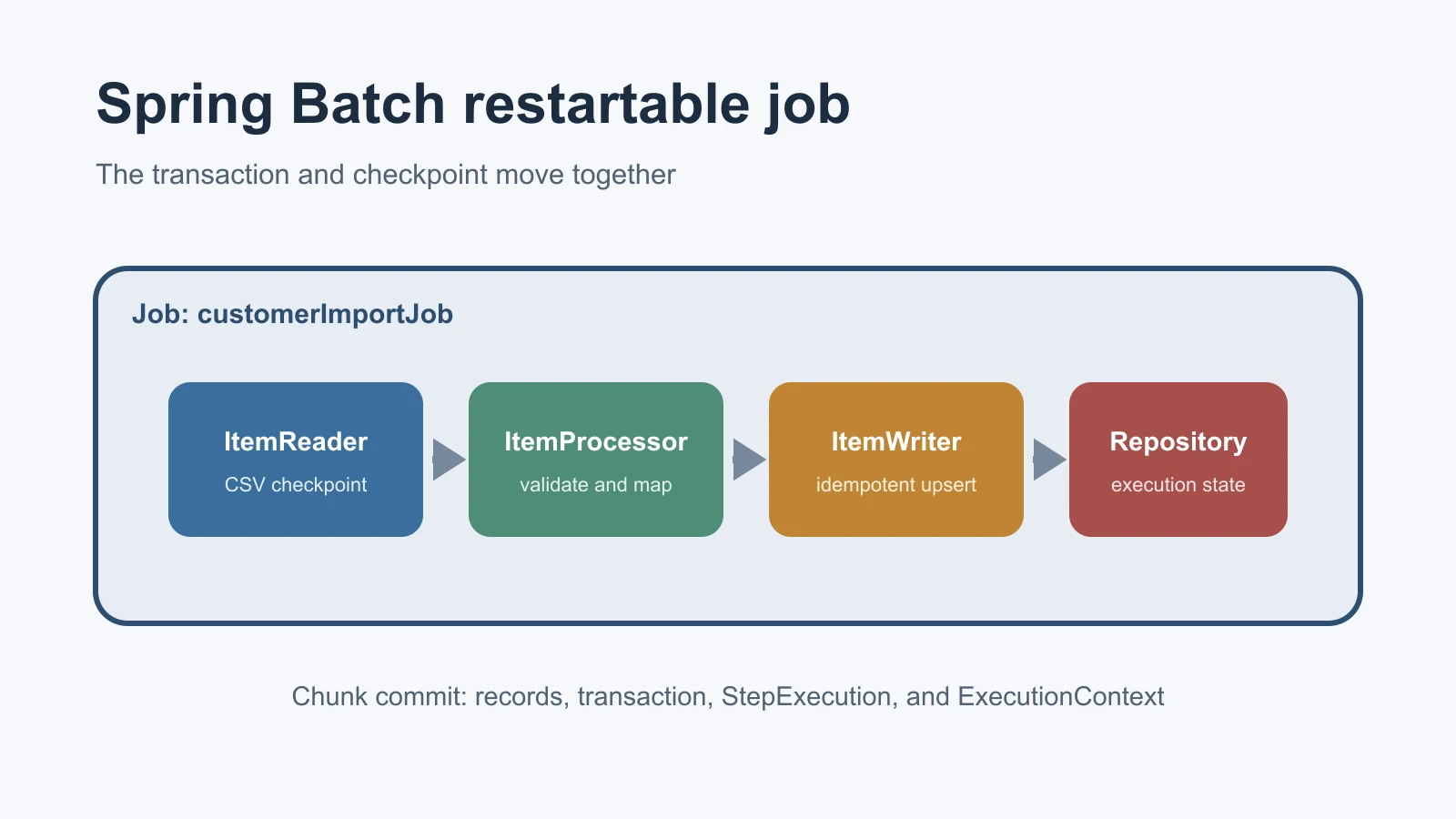
JavaSpring Batch: A Practical Guide to Restartable Jobs
Learn Spring Batch 6 through a restartable CSV-to-database job covering jobs, steps, chunks, metadata, fault tolerance, parameters, testing, and scaling.
Sep 23, 2026
-
 Java
JavaJava File I/O: Read, Write, and Manage Files
A practical guide to Java file I/O: streams, readers and writers, NIO Path and Files, buffering, serialization, and the exceptions that break file code.
Oct 7, 2023
-
 Java
JavaException Handling in Java: Full Guide
How exception handling in Java works: checked vs unchecked, try-catch-finally, custom exceptions, try-with-resources, and the mistakes to avoid.
Sep 25, 2023