PHP, Web Development
7 Popular PHP Frameworks Compared
· Linet M.
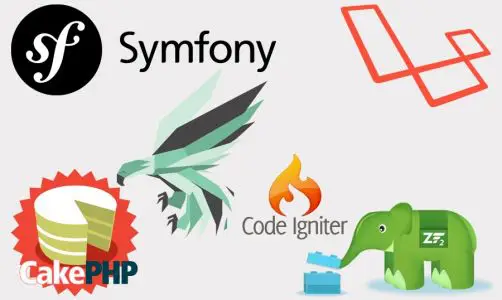
PHP frameworks reduce the cost of building web applications by providing tested, reusable architecture so developers focus on business logic instead of boilerplate. Every framework covered here follows the Model-View-Controller (MVC) pattern: the Model handles data, the View handles presentation, and the Controller handles request routing. That separation keeps code testable and maintainable as projects grow.
What a PHP Framework Actually Does
A framework is a pre-built code base with standardized conventions that a developer fills in to meet project requirements. Compared to writing raw PHP, a framework:
- Handles database connections, input filtering, session and cookie management, email, and date/time formatting through a shared library.
- Enforces MVC separation, reducing coupling between business logic and templates.
- Provides built-in debugging and unit testing tools.
- Enables code recycling across projects with minor modification.
- Speeds up CRUD operations through generated scaffolding rather than hand-written SQL.
Choose a framework when project complexity or team size makes raw PHP maintenance impractical.
7 PHP Frameworks and When to Use Them
1. Laravel
Laravel (released 2011) is the most widely adopted PHP framework in active development. It provides expressive, readable syntax for authentication, sessions, queuing, and caching without verbose configuration.
Laravel fits projects of any size, from small APIs to large enterprise applications. It supports MySQL, PostgreSQL, SQL Server, and SQLite out of the box.
Key features:
- RESTful routing that maps client/server routes to controller actions cleanly.
- Blade templating engine: lightweight, inheritance-based
.blade.phpfiles that sit in the View layer of MVC. - Composer integration for managing third-party packages.
- Migration system for version-controlled database schema changes.
- Artisan CLI for code generation, queue management, and scheduled tasks.
2. CodeIgniter
CodeIgniter targets developers who need a simple toolkit for building fully featured web applications with near-zero configuration overhead. Its core loads only the libraries a given request requires, keeping it fast on shared hosting where other frameworks may be too heavy.
Key features:
- Fast startup with a small footprint; only core libraries load per request.
- Clear documentation that lets a new developer become productive within a day.
- No restrictive coding rules: the framework suggests, not mandates, conventions.
- MVC separation keeps logic and templates apart, which is useful when designers edit templates independently.
- Compatible with standard shared hosting without special server configuration.
3. CakePHP
CakePHP ships with an Object-Relational Mapper (ORM) that lets you query database tables as PHP objects, eliminating repetitive SQL. Its convention-over-configuration approach means database tables with matching model names wire up automatically.
Key features:
- Code generation scaffolding that produces CRUD views and controllers from a table definition.
- No complex config file setup to connect databases; conventions handle naming.
- Built-in validation rules and protection against SQL injection baked into the ORM layer.
- Caching, translations, and database access included in the core.
- Suited for commercial applications where the ORM-level safety guarantees matter.
4. Zend Framework (Laminas)
Zend Framework, now continued as the Laminas Project, is a component library as much as a full framework. Its loosely coupled components can be used individually inside other projects rather than requiring the complete stack.
Key features:
- API-centric application support with fast response times by loading only required components.
- Components pluggable into other frameworks: use the Zend HTTP client inside a Symfony app, for example.
- Online debugging and integrated unit testing tools included.
- No predefined constraints on directory structure or naming conventions outside what you import.
- Drag-and-drop editor and front-end integration support for HTML, CSS, and JavaScript tooling.
5. Yii
Yii is a high-performance PHP framework built to work efficiently with AJAX. Its caching layer is one of the strongest across all PHP frameworks, supporting file, database, APC, Memcache, and Redis backends.
Key features:
- Layered caching system (page, fragment, data) that measurably reduces database load on high-traffic applications.
- Input validation and output filtering against SQL injection and cross-site scripting built into the form model layer.
- Full-text documentation for every class and method.
- Third-party code integration: Zend Framework components can run inside a Yii application without conflict.
- Built-in authentication and role-based access control.
- jQuery and AJAX widgets including autocomplete, tree view, and data grid out of the box.
- Supports both relational databases (MySQL, PostgreSQL, SQLite) and non-relational stores.
6. Symfony
Symfony is the framework underlying several major PHP projects, including Drupal 8+ and Laravel itself (which reuses several Symfony components). It targets complex applications that need long-term stability and maintainability over rapid prototyping.
Key features:
- Stable, backward-compatible components with a documented deprecation policy, which matters for projects maintained over 3-5 years.
- Smart URL routing, code generation, caching, automated form validation, and AJAX support included.
- Full-stack option for complete application scaffolding, or component-only option to add individual Symfony pieces to existing code.
- Clear MVC boundaries: logic in the Model layer, presentation in Twig templates, routing in the Controller.
7. Phalcon
Phalcon (released 2012) takes a different architectural approach from the other six: it is implemented as a C extension to PHP rather than a PHP library. This means its classes and functions are compiled into native code and loaded alongside PHP itself, cutting per-request overhead to near zero.
Key features:
- Delivered as a compiled C extension, so there are no PHP files to parse or load at request time. No C knowledge required to use it.
- Lower memory consumption and CPU time per request than any pure-PHP framework of comparable scope.
- Loosely coupled: use the full framework or load individual components (ORM, template engine, router) independently.
- Native PHP namespace support to prevent class name collisions across modules.
- Universal auto-loader, built-in security filters, and asset management included.
- Supports single-module, multi-module, and micro-application architectures.
Which Framework Should You Use?
| Goal | Framework |
|---|---|
| General-purpose, largest ecosystem | Laravel |
| Fast start on shared hosting | CodeIgniter |
| Strong ORM, convention-based projects | CakePHP |
| Modular, enterprise component library | Zend / Laminas |
| High-traffic with heavy caching needs | Yii |
| Long-term maintainability, large teams | Symfony |
| Maximum raw throughput, C-extension architecture | Phalcon |
All seven follow MVC. The choice comes down to team familiarity, hosting constraints, and how much of the stack you want the framework to own.
Need help with a PHP assignment or project? PHP Programming Assignment Help covers framework setup, ORM queries, REST API design, and debugging. See also 13 PHP Tips That Make Development Faster. For web projects mixing PHP with JavaScript or other languages, Do My Programming Homework handles the full stack.
Related articles
-
 PHP
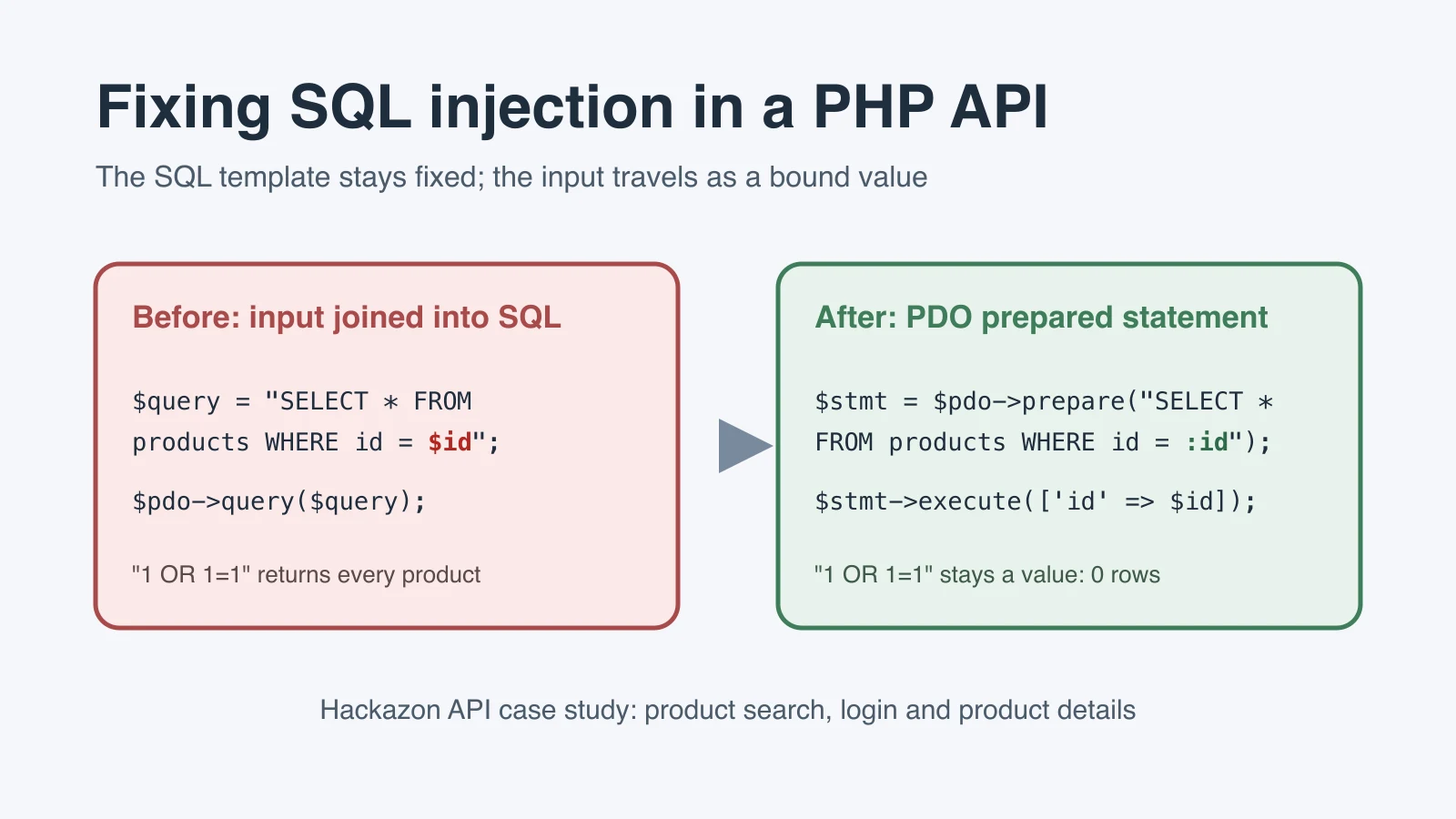
PHPHow to Fix SQL Injection in a PHP Mobile App API
See how three Hackazon API queries were changed from unsafe SQL concatenation to PDO prepared statements, then checked with RIPS and a Burp proxy.
Sep 29, 2026
-
 PHP
PHP13 PHP Tips That Make Development Faster
13 PHP tips covering error reporting, PDO, cURL, password hashing, and more to help you write cleaner, faster PHP code.
Oct 8, 2016
-
 Featured
Programming Project Ideas to Build and Earn
10 programming project ideas for students and developers: web apps, social networks, computer vision, robotics, and open source contribution.
Oct 15, 2014